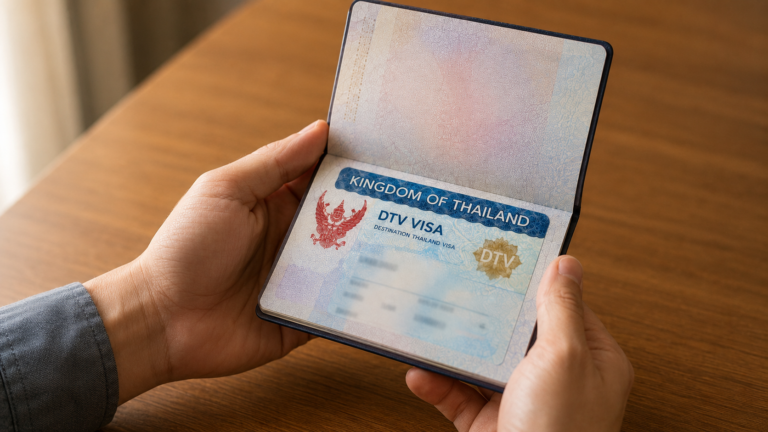
The Destination Thailand Visa (DTV) has given foreigners more flexibility to spend extended periods in Thailand. While much of the attention has focused on digital nomads and remote workers, the DTV soft power category offers another option for those participating in qualifying activities such as Muay Thai training, Thai cooking courses, sports programs, and medical treatment.
However, not every course or program is eligible, and even applicants with legitimate enrollment can face difficulties if their supporting documents or financial evidence do not meet the requirements of the Thai embassy or consulate reviewing their application.
So, which activities actually qualify for the DTV soft power visa, and what should applicants know before applying? This guide explains the eligibility requirements, course duration, financial evidence, supporting documents, and immigration rules that matter before and after approval.
How Does the DTV Soft Power Visa Work?
Before applying, it is important to understand what the Destination Thailand Visa allows and where its limits are. The visa is valid for five years from the date it is issued. It is a multiple-entry visa, which means holders can leave and re-enter Thailand during the visa validity period without applying for a new visa each time.
On each entry, the DTV allows a stay of up to 180 days. In many cases, that stay can be extended once through Thai Immigration for up to another 180 days, creating the possibility of a much longer continuous stay before the applicant needs to leave and re-enter Thailand.
The key limitation is work. The DTV does not provide a Thai work permit and does not allow local employment with a Thai company. It should not be used as a shortcut into the Thai labor market. Applicants who plan to work for a Thai employer, manage local operations, or provide services inside Thailand should consider a business visa and work permit structure instead.
What Actually Qualifies Under the DTV Soft Power Category?
The DTV soft power category is not a general tourist allowance. It is intended for applicants who will take part in structured activities connected to Thai culture, sport, wellness, medical care. In practice, the main qualifying activities include:
- Athletic Training: Traditional Muay Thai programs and professional sports training systems.
- Culinary Arts: Thai cooking and culinary certification courses.
- Medical Care: Long-term medical treatments, specialized therapies, and wellness operations at authorized Thai hospitals or medical centers.
- Cultural and Professional Events: Musical festivals, and formal artistic training.
The important point is that the activity must be real, organized, and supported by proper documentation. Applicants should expect to provide evidence such as an acceptance letter, booking confirmation, course details, treatment plan, or documents from the Thai institution, clinic, organizer, or program provider.
Thai language study should be treated separately. Applicants seeking long-term Thai language education usually need to consider the Education visa route, which has its own requirements, school approvals, reporting obligations, and Ministry of Education oversight. A language course should not be assumed to qualify automatically under the DTV soft power category.
Program Duration and Supporting Documents
One of the most common reasons DTV soft power applications face problems is the gap between the length of the activity and the length of the visa being requested.
The official rules do not always state a fixed minimum course duration in simple terms. In practice, however, embassies and consulates often look closely at whether the selected program genuinely supports a long-term visa application. A short cooking class, brief Muay Thai camp, or one-month activity may not be enough to justify a five-year, multiple-entry visa.
For that reason, applicants should choose a serious, well-documented program. A longer course, often around six months or more, is generally easier to justify because it shows genuine commitment to the soft power activity and better matches the long-stay purpose of the DTV.
The institution also matters. The school, gym, hospital, clinic, or program provider should be properly registered and able to issue credible supporting documents. A strong application usually includes:
- An official acceptance of invitation letter
- Proof of business registration
- Relevant licenses or approvals, where applicable
- A detailed course outline, treatment plan, or activity schedule
- Payment receipts or proof of enrollment
- Documents showing the provider is authorized to offer the activity
For Muay Thai or sports programs, additional evidence from relevant sports or boxing authorities may strengthen the application. For medical or wellness programs, documents from an authorized hospital, clinic, or treatment provider should clearly explain the treatment or program.
The main point is simple: the DTV soft power visa is not approved just because an applicant signs up for an activity. The program must look real, substantial, and properly supported by the institution behind it.

DTV Soft Power Visa Financial Requirements
The DTV financial requirement is widely known: applicants must show access to personal funds of at least 500,000 THB, or the foreign currency equivalent. What many applicants underestimate is how closely embassies and consulates review the quality of that financial evidence.
In the early stages of the DTV rollout, some applicants relied on a simple bank snapshot showing the required balance on a single day. That approach is now much weaker. Officers want to see that the funds are genuinely available to the applicant, not temporarily moved into the account only for the purpose of the application.
In practice, applicants should prepare clear bank statements covering the previous three to six months. The account should be in the applicant’s legal name, and the balance should remain consistently strong throughout the statement period. A strong financial file usually shows:
- At least 500,000 THB, or the equivalent in foreign currency
- Funds held in a personal savings or checking account
- Bank statements covering the requested period
- A consistent balance, not a sudden last-minute deposit
- The applicant’s full legal name clearly shown on the account
Applicants should also be careful about relying on alternative assets. Cryptocurrency holdings, stock portfolios, investment accounts, or illiquid wealth products may not be accepted as proof of available funds. For DTV purposes, the safest evidence is liquid money held in a verified personal bank account.
Visa Extensions and Immigration Requirements
Getting the DTV approved is only the first step. Once inside Thailand, visa holders must still follow normal immigration procedures. On entry, DTV holders are usually granted up to 180 days. To stay longer without leaving Thailand, they must apply for an extension at a local Immigration office using Form TM.7 and pay the standard 1,900 THB fee.
Extensions are not automatic. Immigration may ask for updated proof that the soft power activity is still active, such as a new acceptance letter, course confirmation, treatment update, or program schedule.
If the original activity has ended and no new qualifying activity can be shown, the extension may be refused. DTV holders staying in Thailand for more than 90 consecutive days may also need to complete 90-day reporting using Form TM.47. All arrivals must also comply with the Thailand Digital Arrival Card, or TDAC, when entering the country.
Frequently Asked Questions
Can I apply for a DTV soft power visa while staying inside Thailand?
No. You must apply from outside Thailand via the official e-visa portal or at a Royal Thai Embassy or Consulate. Attempting to apply from within the country while misrepresenting your location can carry severe legal and immigration consequences.
Does the 500,000 THB requirement apply to each dependent?
DTV dependents, including spouses and children under 20, may also need to provide financial evidence of at least 500,000 THB. However, this does not necessarily mean each dependent must hold that amount in a separate personal bank account. The exact financial documentation requirements depend on the embassy or consulate processing the application.
What happens if my soft power program ends early?
If you seek to extend your 180-day entry stamp within Thailand, immigration officials will review the status of your enrollment. If the course has concluded, you must secure a new acceptance letter for a new qualifying soft power activity or depart the country to reset your status.
What to Consider Before Applying
The DTV soft power visa can be a strong long-term relocation option, but it needs to be handled carefully. Approval depends on choosing a credible host institution, preparing clear financial evidence, and making sure the activity genuinely fits the soft power category.
This pathway should not be treated as a loophole or an easy alternative to a proper long-stay visa. Weak documentation, unclear enrollment, or inconsistent financial records can lead to delays, refusals, or future immigration problems.
If you are considering the DTV soft power visa as part of your long-term Thailand plan, SVBL can review your eligibility, assess the host institution, and help structure your application around current embassy and immigration expectations.