Relocating to Thailand is often treated as a visa project. Which visa should you apply for? How long can you stay? What documents do you need before arrival? Those questions matter. But once the visa is approved, a different challenge begins.
For expatriate families, founders, executives, remote professionals, retirees, and long-term residents, the real challenge is not simply relocating to Thailand. It is building a legally coherent, practical, and sustainable life after arrival.
This guide breaks down the essential post-arrival steps you need to manage to ensure a seamless, secure, and fully compliant transition for your life, family, or business.
What Post-Visa Settlement Really Means
Post-visa settlement is the process of turning legal permission to stay in Thailand into a practical life on the ground.
It covers the decisions and procedures that come after visa planning: where to live, how to sign a lease, how to place children in school, how to open a bank account, how to arrange healthcare, how to manage transport, how to connect utilities, and how to operate within Thai administrative and cultural systems.
This matters because relocation issues are interconnected. A housing decision affects school access. School access affects transport. Transport affects daily routine. Visa category can affect banking, work authorization, dependant status, and future renewals. Healthcare access may influence where a family should live. A lease signed too quickly can create avoidable legal and financial problems later.
A strong relocation plan does not treat these as isolated tasks. It sequences them. That is the difference between simply moving to Thailand and settling in Thailand properly.

1. Document Legalization and Customs Compliance
A successful transition begins long before your flight lands. One of the most common oversights during the process of relocating to Thailand is the failure to properly coordinate personal asset shipping and document legalization ahead of time.
Personal Effects and Customs Compliance
Shipping household goods into Thailand requires strict adherence to Department of Customs protocols. Foreign nationals often assume their long-term visa automatically grants duty-free import status for personal belongings. In practice, duty exemptions are highly restrictive and typically tied to specific work permit categories or explicit LTR visa privileges.
Importing household items without the correct matching documentation or under an unapproved visa class triggers substantial import duties, port storage fees, and customs delays. Every consignment must be meticulously itemized, and shipping timelines must be synchronized with your legal arrival date to ensure smooth clearance.
Document Legalization Frameworks
Thailand is not a member of the Apostille Convention. Consequently, foreign public documents (such as marriage certificates, birth certificates, corporate records, and academic transcripts) cannot be validated with a simple apostille stamp.
To be legally recognized by Thai government departments, international schools, or local banks, your documents must undergo a multi-tiered legalization process. This requires authentication by the issuing government body in your home country, followed by final legalization at the Royal Thai Embassy or Consulate. Managing this chain of authentication post-arrival is exceptionally difficult and can paralyze your settlement timeline.
2. Navigating the Thai Housing Market
Securing a premium property when relocating to Thailand involves much more than browsing digital listings or evaluating neighborhood aesthetics. The local real estate landscape operates under distinct legal and structural norms that foreign tenants must actively manage.

The Realities of Thai Lease Agreements
While property marketing is universally presented in English, the legally binding version of a residential or commercial lease agreement is frequently drafted in Thai. Foreign tenants regularly execute generic contracts that lack critical protections regarding security deposit returns, maintenance liabilities, and early termination clauses.
Before signing any agreement, it is vital to ensure the contract includes clear provisions defining the landlord’s responsibility for structural repairs, utility billing transparency, and a contractually protected process for the return of your security deposit.
Location Logistics and Zoning
Choosing a residential zone requires mapping your daily operational footprint. Evaluating a property must go beyond the physical structure to include a rigorous analysis of seasonal traffic patterns, practical commute times to key business districts, and proximity to international schools and premium medical facilities. Relying on superficial map distances without understanding localized infrastructure limitations can lead to unmanageable daily travel constraints.
3. International Schooling and Dependent Visas
For expat families, educational continuity is one of the most critical components of a successful relocation. Thailand offers a wide range of international schools, particularly in Bangkok, Chonburi (including Pattaya), Chiang Mai, and Phuket, as well as other locations such as Koh Samui, Hua Hin, Chiang Rai, and Nakhon Ratchasima. However, navigating the enrollment process requires careful planning and adherence to individual schools’ admission timelines.
For a comprehensive list of international schools across Thailand, please refer to the International Schools Database.
Enrollment Windows and Capacity Constraints
Premium international schools in Thailand operate on highly competitive, structured application timelines. Waiting lists for top-tier institutions following British, American, or International Baccalaureate (IB) curricula can span several months or even academic years for specific grade levels. Families relocating to Thailand cannot afford to treat school placement as a post-arrival task; assessments, entrance interviews, and application submissions must be initiated months in advance.

Visa Synchronicity for Dependents
Securing a school placement is also a mandatory legal requirement for obtaining your family’s long-term residency status. Once a student is formally accepted, the educational institution must issue specialized regulatory documentation to support a Non-Immigrant ED visa application. This status then allows accompanying parents to apply for dependent extensions of stay (Non-Immigrant O visas), binding your family’s legal right to stay directly to your children’s educational enrollment.
4. Financial Compliance and Banking Setups
Opening a local bank account has become one of the most visible friction points for foreigners relocating to Thailand. Due to the systematic tightening of global anti-money laundering (AML) and know-your-customer (KYC) standards, Thai commercial banks have significantly increased their documentation requirements, completely ending the era of casual walk-in openings.
The Residency Requirement Barrier
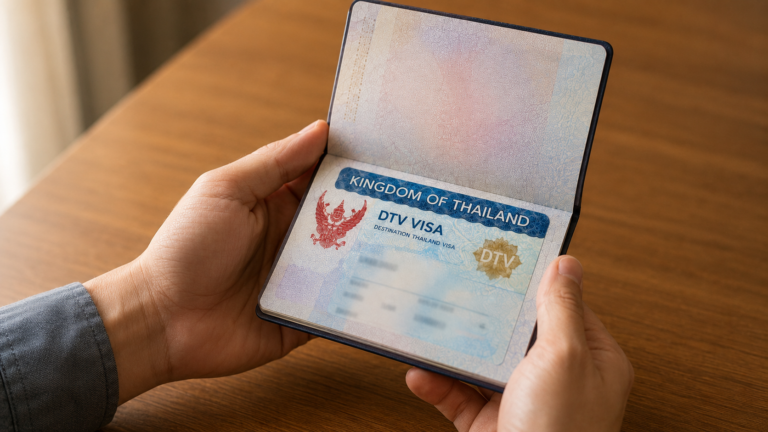
Major financial institutions now systematically reject applicants holding short-term stamps, tourist visas, or even the 5-year Destination Thailand Visa (DTV) unless the individual possesses structured institutional backing. The DTV, despite its length, is legally classified under a tourist entry framework, meaning banks do not automatically view it as an anchored residency.
To successfully clear compliance screens, foreign nationals must present a precise assembly of validating documents:
- A verified long-term visa stamp (such as an LTR, DTV, or Non-Immigrant Business Visa).
- An officially registered work permit or a formal certificate of employment from a licensed Thai juristic person.
- A formal TM30 immigration filing confirmation or a certified Certificate of Residence, paired with a long-term residential lease agreement.
- Your Thai mobile phone number must be officially registered in your exact passport name to activate mobile banking applications and pass automated anti-fraud monitoring.
- Your original ID Card or driver’s license from their home country (in English).
- An account must be opened near your office or your residence.
Requirements vary not only between different banking institutions but also between individual branches of the same bank. Arriving without pre-vetted documentation typically results in immediate service rejections.

Stricter Control on Inbound Wealth: Circular No. 8434/2568
For high-net-worth individuals and corporate executives remitting capital for property purchases or investment visas, the Bank of Thailand enforces strict inbound verification protocols. Under BOT Circular No. 8434/2568, banks are legally mandated to scrutinize and hold any incoming foreign-exchange transfer equivalent to $200,000 USD or more.
To release these funds into your local account, you must present direct supporting documents such as finalized property sale agreements, historical bank statements from the sending institution, or verified corporate UBO records proving the lawful source and exact intended use of the capital.
5. Settlement Infrastructure and Long-Term Stability
Completing your transition requires aligning your daily operational infrastructure with local legal frameworks.
Domestic Driving Privileges
While an International Driving Permit (IDP) is legally valid for your initial months in the country, long-term residents are required to obtain a formal Thai driving license. Driving indefinitely on an overseas license invalidates local comprehensive insurance policies, leaving you exposed to severe financial and legal liability in the event of an accident.
Converting a foreign license into a Thai driving license requires a structured visit to the Department of Land Transport (DLT). This process demands a verified Certificate of Residence issued by Thai Immigration or your embassy, alongside a formalized medical certificate confirming physical fitness.
Healthcare Integration and Medical Insurance
Thailand boasts exceptional private healthcare infrastructure, but accessing these facilities with complete peace of mind requires a well-structured medical insurance policy. For certain visa categories, holding a specific level of local or international health insurance coverage is a statutory requirement for ongoing visa extensions.
Expats must ensure their policies explicitly satisfy these regulatory minimums while providing robust coverage for emergency medical evacuation, inpatient treatment, and local hospital direct-billing networks.
6. Navigating Tax Residency & The 180-Day Rule
Tax compliance is a critical, often misunderstood component of relocating to Thailand. Tax residency is determined by a strict, aggregate day-count rule, completely separate from your underlying visa type.
- The 180-Day Rule: Any individual who resides in Thailand for a cumulative total of 180 days or more within a single calendar year (January 1 to December 31) is legally classified as a Thai tax resident.
- The Remittance Reality: Under current Revenue Department Departmental Instructions, Thai tax residents are subject to personal income tax on foreign-sourced income (including offshore salaries, dividends, and investment yields) if that income is remitted into Thailand.

To mitigate unexpected exposure, relocating individuals must maintain absolute financial separation. Inbound transfers must be backed by pristine historical records proving the capital represents wealth accumulated prior to the current tax year.
Note: LTR visa holders remain uniquely protected from foreign-sourced income remittance taxes under the specific statutory exemptions of Royal Decree No. 743.
Achieving Seamless Settlement with SVBL
Successfully relocating to Thailand demands an operational strategy that extends far after visa approval. Managing the logistical overlapping of international shipping, educational registration, financial compliance, and real estate acquisition requires expert oversight and deep local knowledge.
SVBL provides comprehensive, end-to-end relocation support tailored specifically to foreign founders, corporate executives, and international families. Our specialized Pre-Arrival Consultancy coordinates your documentary preparation, housing searches, and school placements well before your arrival. Post-arrival, your dedicated SVBL relocation consultant personally manages your banking setups, driver’s licensing, utility connections, and administrative compliance filings, ensuring nothing is lost in translation.
To transition your move into a seamless, strategically managed milestone, contact SVBL today to arrange a professional long-term relocation and settlement consultation.